
The Rise and Fall of the Indo-Scythian Empire's Monetary System
EDUCATION ON GOLD & SILVER
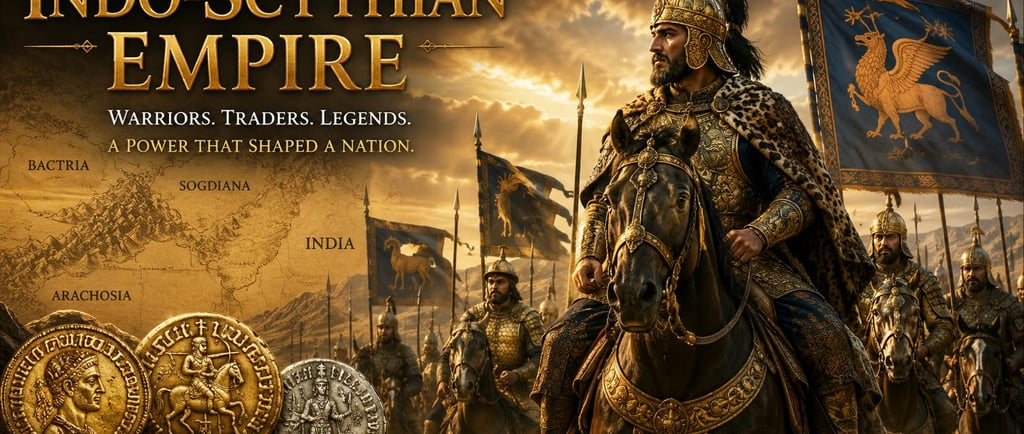
Historical Overview of the Indo-Scythian Empire (150 BC - 395 AD)
The Indo-Scythian Empire, emerging around 150 BC, marked a significant phase in the history of South Asia, encompassing regions that now fall within modern-day India, Pakistan, and Afghanistan. This period witnessed the ascendance of various nomadic tribes, notably the Scythians, who migrated from Central Asia, bringing with them distinct cultural and monetary practices. Under the leadership of influential rulers such as Maues and Azes, the empire established a robust trading network and a progressive monetary system that facilitated economic expansion.
Maues, often credited as the founder of the Indo-Scythian Empire, played a pivotal role in consolidating power in northwest India. His reign was characterized by military conquests and an aggressive expansion policy. The introduction of a standardized currency during his time significantly impacted trade, allowing for a more cohesive economic environment. Coinage from this era, often adorned with intricate designs, reflected both Hellenistic influences and local traditions, signifying a melding of cultures that defined the Indo-Scythian identity.
Following Maues, Azes ascended to the throne around 30 BC, further refining the monetary system established by his predecessor. Under Azes, the empire experienced one of its most prosperous phases, with increased minting of coins that featured not only Scythian imagery but also Greek inscriptions. This promotion of a unified currency system stimulated trade across diverse regions, linking the Indo-Scythian territories with major trade routes that connected the East to the West.
However, the stability of the empire began to wane by the late 1st century AD due to internal strife and external pressures, including invasions from neighboring entities. This decline culminated by 395 AD, marking the end of the Indo-Scythian Empire and the dissolution of its monetary system. The historical developments during this period underline the significance of leadership and economic strategies in shaping an empire's trajectory, setting the stage for subsequent powers that would rise in the Indian subcontinent.
Key Features of the Indo-Scythian Monetary System
The Indo-Scythian monetary system was characterized by a sophisticated array of coinage that reflected the diverse economic needs of the empire. Central to this system were the drachms and tetradrachms, which were primarily minted from silver and copper. Silver drachms were particularly notable for their weight and design, making them a favored medium for trade, while the tetradrachms provided a higher denomination, facilitating larger transactions.
One significant aspect of the Indo-Scythian monetary system was the preference for silver and copper over gold for everyday transactions. This can be attributed to several factors, including the relative abundance of these metals compared to gold, as well as their practical suitability for trade. Silver, with its intrinsic value and durability, proved to be an effective currency for both local exchanges and long-distance trade, promoting economic stability in the region.
The use of copper coins further expanded the lower range of transactions, allowing for even more accessibility to a broader segment of the population. In contrast, gold held a more symbolic significance within the Indo-Scythian society. While it was less commonly used for daily trade, gold was associated with personal ornamentation and status display, reflecting wealth and power. This dichotomy in the usage of metals illustrates the socio-economic fabric of the Indo-Scythian society, where different materials served distinct purposes.
Gold coins, reserved for elite transactions and ceremonial uses, highlight the social stratification within the empire. The prominence of silver and copper in the monetary system enabled a vibrant market economy, thereby underscoring its importance to the Indo-Scythian political and cultural landscape.
Economic Impact of Leadership and Decisions on Coinage
The Indo-Scythian Empire, which thrived between the 3rd century BC and the 1st century AD, experienced significant economic transformation largely influenced by its leadership and their decisions regarding coinage. The rulers of this empire, including the notable king Maues, embraced a systematic approach to coinage that was crucial for facilitating trade, both within their territories and with neighboring civilizations such as the Greeks and Indians.
Leadership decisions directly impacted the stability of the monetary system. For instance, the introduction of standardized coins made from high-quality metals enhanced trust in the currency, thereby fostering trade relations. These coins often bore the images of the rulers, which not only served as a means of currency but also as tools for political propaganda, reinforcing the authority and reach of the leaders.
The strategic decisions taken by the Indo-Scythian rulers also modified existing trade routes and established new ones. By issuing new coinage, they bolstered trade networks across the vast territories they controlled. This adaptation created a more cohesive economic framework that allowed for increased interactions with diverse cultures, thus enriching the economic landscape of the empire. Moreover, the leaders were strategic in their alliances and conflicts, which further influenced the economic stability of the region.
However, not all reforms led to positive outcomes. In some instances, political instability or poor leadership choices resulted in depreciation of coin values, leading to economic disruption. This fluctuation illustrated how imperative it was for the rulers to maintain control over monetary policies and political decisions. As the Indo-Scythian Empire progressed, the correlation between leadership efficacy and the integrity of its coinage system became increasingly evident, marking the leaders' decisions as pivotal in dictating the rise or decline of the empire.
Lessons from the Indo-Scythian Monetary System for Modern Economies
The monetary practices of the Indo-Scythian Empire present integral lessons that could significantly shape contemporary economic frameworks. The Indo-Scythians primarily utilized silver and copper coins as tangible forms of money, which facilitated trade and economic stability. This reliance on physical assets fosters the idea that a sound monetary system should ideally be backed by real, tangible resources rather than abstract representations, such as fiat currencies or digital equivalents.
In today’s rapidly evolving financial landscape, characterized by the dominance of fiat currencies, there is a growing discourse regarding the intrinsic value of money. The Indo-Scythian Empire’s approach underscores the advantages of anchoring currency systems in physical commodities. Such a model could potentially offer greater stability, as the value of tangible assets tends to be less volatile compared to fiat currencies, which can be influenced by government policies and economic fluctuations.
Moreover, the historical experiences of the Indo-Scythians emphasize the importance of maintaining trust and confidence in the monetary system. The issue of currency devaluation is reminiscent of contemporary challenges faced by many economies, where excessive printing of money can lead to inflation. By learning from the practices of the Indo-Scythian Empire, modern economies could benefit from re-evaluating their monetary policies. Encouraging the use of tangible assets as a measure of value would not only instill trust but could also foster a more sustainable economic environment.
Additionally, examining the historical reliance on physical money urges a reflection on the principles of value, trade, and economic growth. As societies evolve, revisiting these ancient practices might yield innovative strategies for establishing resilient monetary systems that resonate with contemporary needs while learning from past successes and failures.